UBcore OS
The enterprise's cognitive layer.
It holds the memory of what your company knows and puts reasoning to the test, alongside those who must decide.
An exoskeleton for the judgment of those who decide. At their side, never in their place.
Currently in closed beta.
The blind spot
AI answers. But the answer, where does it come from?
Today, AI in the enterprise is used like an oracle: you ask a question, you get an answer, you take it at face value. That works, as long as the decision is small. When it carries weight, you need to know where that answer comes from, and whether the model trusted itself too much.
That blind spot explains why the most powerful tools are used today at a fraction of their capability.
Where UBcore lives
Above the operational automations. Alongside those who decide.
The technology stack of structured enterprises has three floors. The first two are crowded with established tools. The third is the floor where strategic choices take shape, and it is still largely to be inhabited. That is where UBcore lives.
strategic decision, the decision-maker's thinking
UBcore lives here
advanced RPA, advanced RAG, operational agents, process copilots
the domain of boutique AI and advanced system integrators
ERP, CRM, data warehouse, ticketing, document systems
consolidated market (SAP, Dynamics, Salesforce, HubSpot, Zucchetti)
UBcore does not replace the systems you already use. It lives above them and brings them into dialogue with strategic thinking.
A day with UBcore
What it does, in a working day.
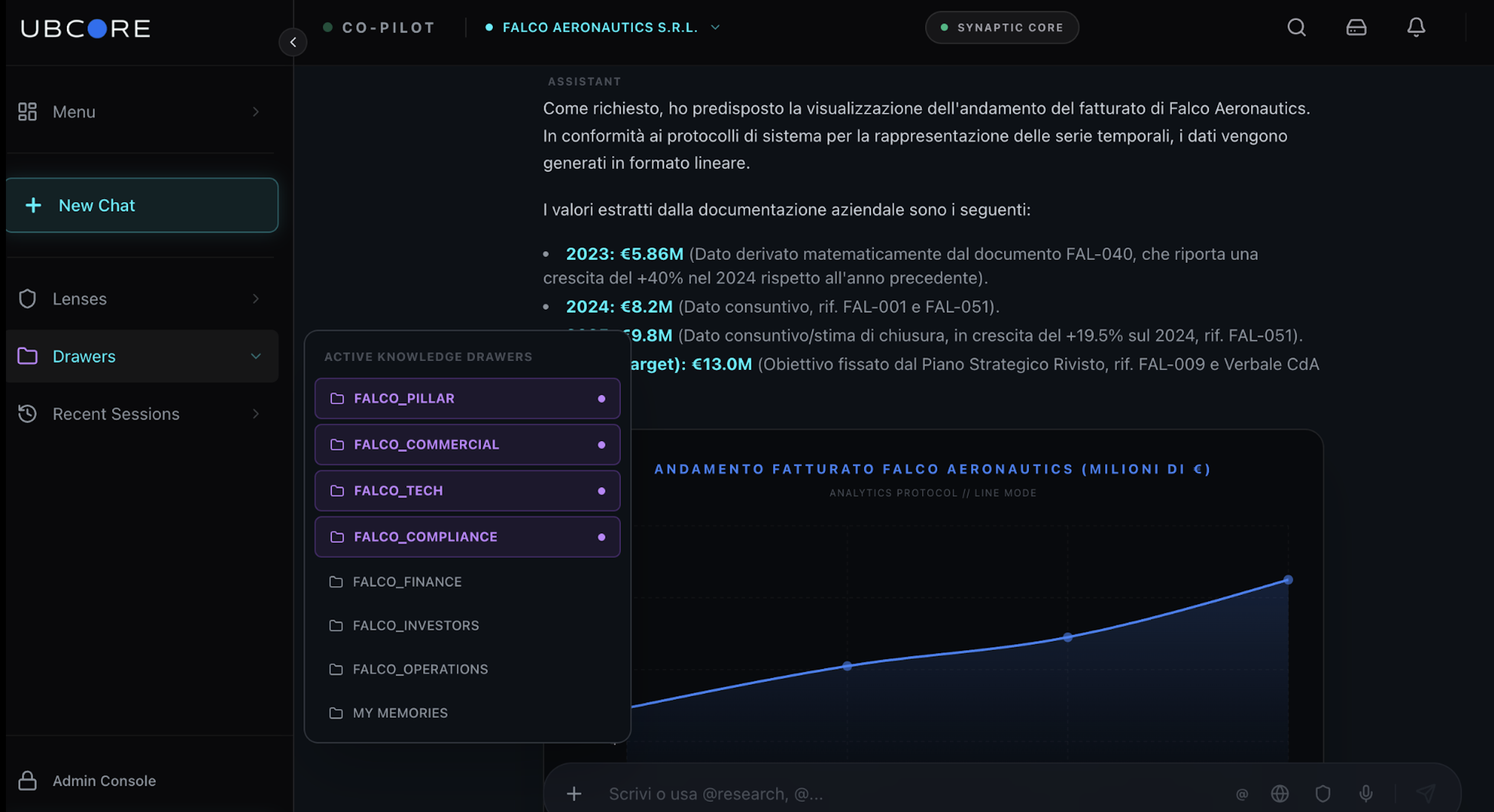
UBcore opens in the browser the way email opens: a conversation with a system that knows your company. In the morning it retrieves a contract, cross-checks it against a procedure, prepares a summary before a meeting.
“Knows your company” does not mean only the text in the documents. It means the quarter's closing figures inside a finance report, the specific clause on page seven of a supplier contract, the selection criterion you codified two years ago and forget to apply to a new negotiation. Every document is a world: text, data, numbers, key information. UBcore reads all of it.
In the afternoon it helps the marketing lead revise a buyer persona in light of the data gathered in recent surveys, or builds with the CEO the positioning for a new market, reading sector reports and the targeting criteria the company has codified. These are areas where Italian SMEs are bringing in-house competences they delegated to outside consultants until yesterday.
In the moments that matter it changes register: it puts reasoning to the test, articulates the choice from several angles, flags where the initial reading might have a blind spot. Same tool, same memory. You do not switch tools when the question turns serious.
How it does it
Four capabilities with a name and a job.
Memory Cosmos
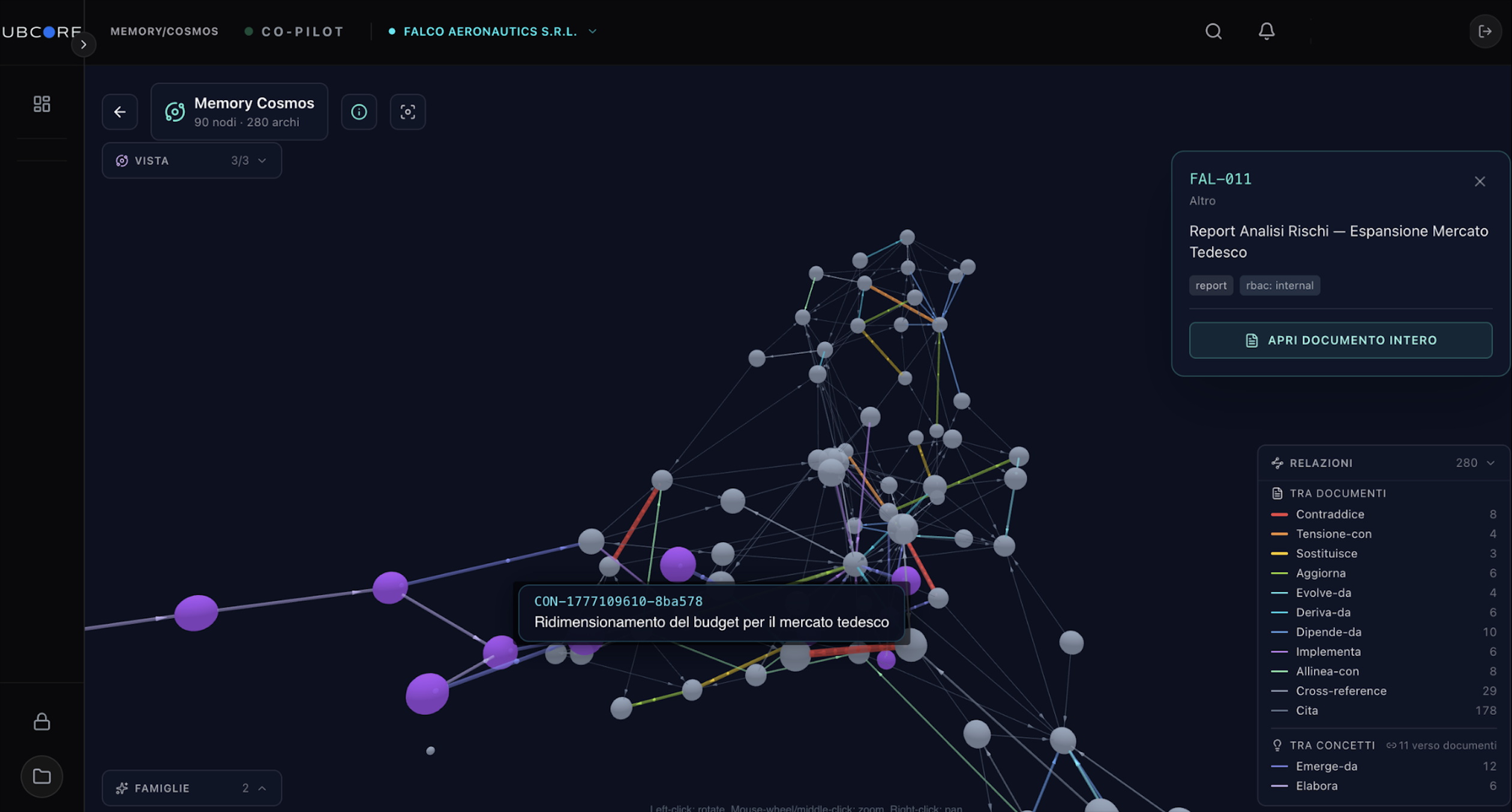
A company's knowledge is not a flat archive, it is a network. Memory Cosmos recognizes how documents speak to each other: what contradicts what, what supersedes what, which version of a position holds today.
When the board minutes cite a strategic plan that was replaced in September, Memory Cosmos knows it, and flags it before internal communication carries the error forward.
All of this for a precise reason. An AI system is worth as much as the knowledge that feeds it: if noise goes in, noise comes out. Memory Cosmos keeps the knowledge base in order, active, up to date. That is what separates a reliable cognitive layer from copy-pasting documents into a model.
Decision Quartet
In moments of weight, UBcore does not trust a single model. It puts reasoning to the test from four sides: the thesis against its antithesis, the claim against research, one voice against another.
For example: before finalizing the positioning of a new product, the system builds the thesis (why this target works), opposes it with its own antithesis (why it might not), and returns a synthesis with the explicit conditions under which one or the other holds. The decision-maker sees the angle their initial framing was hiding.
Four ways of never trusting a single answer.
Deterministic Layer
The Decision Quartet tests the reasoning. But a decision does not rest on reasoning alone: it rests on data. And data must be certain, not plausible.
The Deterministic Layer is the part of the system that calculates with code, not with the model. Key numbers, such as margins, concentrations and variances, are produced by code, with explicit rules. The model reads them, contextualizes them, narrates them: but does not invent them. When an indicator crosses a threshold defined by the company, the system signals it with certainty, not goodwill.
The guarantee is not in the model's answer. It is in the calculation that comes before.
Foundational Layer
From scattered documents to a company that reasons, there is a leap. Every AI system promises “connect your data and go”: in reality it does not work, because a company's knowledge lives scattered, contradictory, outdated.
The Foundational Layer covers that leap with a path. It maps what the company already knows. It helps leadership formalize the non-negotiable principles. It identifies the documents that become the backbone. Only then does the system switch on reasoning. First the grammar, then the reasoning.
You stay in control
No black box.
UBcore does not lock you in a black box. You choose which artificial intelligence engine to use, and you change it whenever you want: it is a configuration, not a rebuild. Your data stays yours, exportable at any time. You decide what the system can and cannot do.
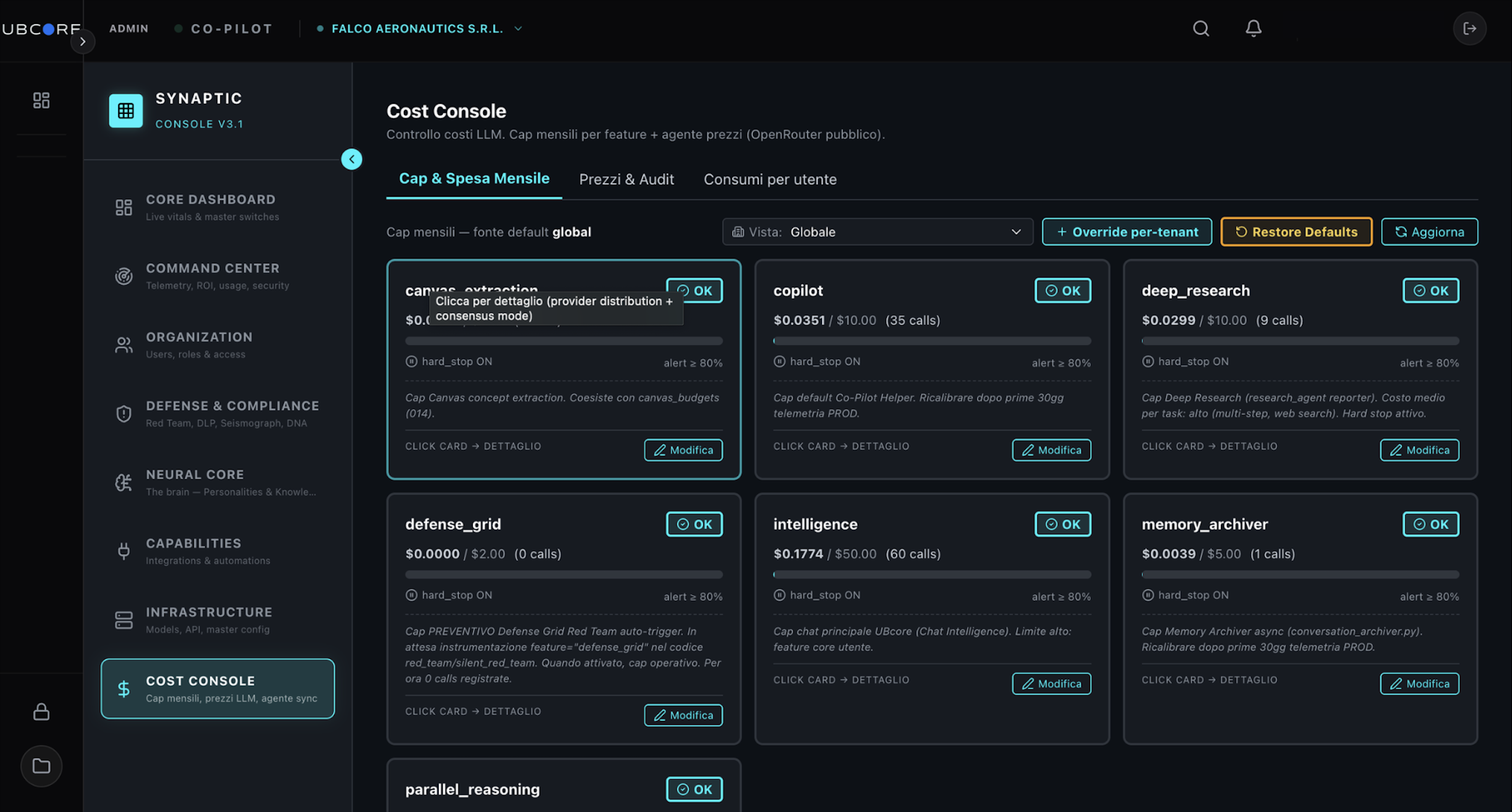
And spending has a brake: a monthly ceiling for each function, beyond which the system stops instead of overspending. The system monitors provider prices on its own and signals when they change.
In service and under construction
What works, and what is still under construction.
UBcore is a platform in service. It is also a work in progress: some functions are in piloting, others in development. The status of every work stream is stated openly: what works, you see in full; what is under construction, you know for what it is.
The Deterministic Layer is in service: structured data calculation and threshold-based monitoring. Automatic table extraction from PDF documents is in piloting in the concrete case.
Who it's for
For those who lead a company and must decide.
UBcore is for those who lead a company and must decide. It is a cognitive exoskeleton: the decision-maker's tool, not a replacement for the decision-maker. We bring it to these companies through two partner profiles.
AI boutiques and system integrators
AI boutiques and advanced system integrators live in the layer of the client's operational automations. Adding the cognitive layer to their portfolio means being able to address a different interlocutor within the same client: no longer only the IT manager assessing a new automation, but the leadership looking for a tool for strategic choices. The interlocutor changes, the conversation changes, the relationship with the client changes.
Advisors and operating partners
Strategic advisors and operating partners with real clients and established top-level relationships, who recognize in the cognitive layer a tool to introduce into the conversations they already lead. With these figures we look for a dialogue: to meet, read the problem together, understand whether there is ground for what may come next.
For those who want to go deeper before a conversation, beyond the White Paper there is extended technical and operational documentation available: architectural details, technical qualification dossiers, operational manuals. We share it case by case, after an initial conversation. On request we also show the system at work, in a demo on a concrete case.
The UBcore manifesto.
We build tools the decision-maker keeps alongside, not in their place.
We measure AI by the reasoning it produces, not the speed of the answer.
We work without hype, because those who decide have no time for noise.
UBcore Perspective
What we think. What we see.
UBcore Perspective is the lab's notebook. Readings of the 2026 AI market, reflections on strategic decision-making in companies, technical notes from the workbench. No promotional newsletter: only what is worth writing.
The ROI of the invisible
What no one puts on the balance sheet: the value of better decisions, not just cutting cost and time.

Is your AI system secure — and can it prove it?
Why the security of an AI system is not a technical topic: it is a condition of trust.

Automating chaos
The hard ceiling of autonomous agents without strategic governance.